In this Module
What is the First Nations Holistic Lifelong Learning Model?
The First Nations Holistic Lifelong Learning Model uses a stylized graphic of a living tree to depict learning as a cyclical process that occurs throughout the individual’s lifespan. This learning tree identifies the conditions that foster cultural continuity and provide the foundation for individual learning and collective well-being. The model contains four main components. They depict the dynamics that enable First Nations people to experience holistic lifelong learning as a purposeful developmental process.
First Nations Holistic Lifelong Learning Model
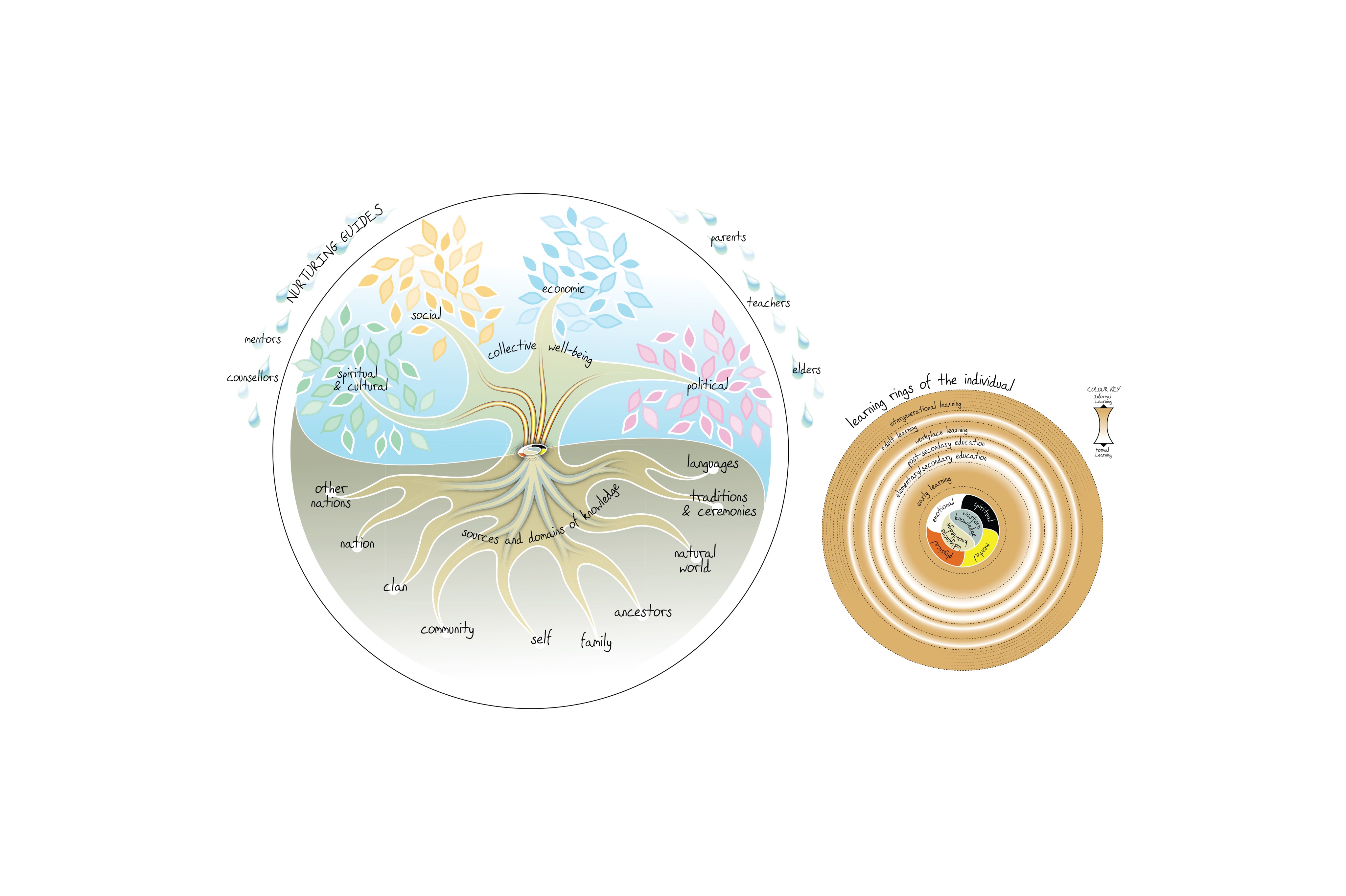

Collective well-being. Growing from each branch is a cluster of leaves, corresponding to the four branches of Collective Well-being–cultural, social, political and economic. Vibrant colours indicate aspects of collective well-being that are well developed.
Collective well-being involves a regenerative process of growth, decay and re-growth. The leaves fall and provide nourishment to the roots to support the tree´s foundation. Similarly, the community´s collective well-being rejuvenates the individual´s learning cycle.
Individual well-being. The individual experiences personal harmony by learning to balance the spiritual, physical, mental and emotional dimensions of their being. The model depicts these dimensions of personal development as radiating upward from the trunk into the tree´s four branches; each branch corresponds to a dimension of personal development.
The emotional branch, for example, may exemplify the individual´s level of self esteem or the extent to which he or she acknowledges personal gisfts. Likewise, the intellectual branch may depict the level of critical thinking ability and analytical skills, or level of understanding and use of First Nations language.
Sources and Domains of Knowledge. Lifelong learning for First Nations people is rooted in their relationships within the natural world and the world of people (self, family, ancestors), and in their experiences of languages, traditions and ceremonies.
These Sources and Domains of Knowledge are represented by the 10 roots that support the tree (learner), and the Indigenous and Western knowledge traditions that flow from them. Just as the tree draws nourishment through its roots, the First Nations individual learns both from and about the sources and domains of knowledge. Any uneven root growth–expresed, for example, as family breakdown, loss of First Nations language–can destabilize the learning tree

A cross-sectional view of the trunk reveals the seven Learning Rings of the Individual. At the trunk´s core, Indigenous and Western knowledge are depicted as two complementary learning approaches.
Surrounding the core are the four dimensions of personal development–spiritual,emotional, physical, and mental–through which learning is experienced.
The tree´s rings portray how learning is a lifelong process. The rings depict the stages of formal learning, from early childhood through post-secondary education and to adult skills training and employment. However, the rings also show the important role of experimential or informal learning. Learning opportunities are available in all stages of life and across all places of learning such as in the home, on the land, or in the school.
The First Nations Holistic Lifelong Learning Model is premised on the understanding that the First Nation learner dwells in a world of continual reformation, where interactive cycles, rather than disconnected events, occur. In this world, nothing is simply a cause or an effect, but is instead the expression of the interconnectedness of life. These relationships are circular, rather than linear, holistic and cumulative, instead of compartmentalized.
“[The purpose of Aboriginal learning] is to contribute to becoming a whole human being…This means that learning can be acquired only by being a full participant in life. This includes participating in the ceremonies, work life, joy and humour that exists in each Aboriginal community.”
— Dr. Lorna Williams, Keynote address at the Aboriginal Learning Knowledge Centre’s National Conference, 2008